Ball joint tools are essential for removing and installing ball joints in automotive suspension systems. Each type is designed for specific tasks, ranging from precise separation to heavy-duty pressing. Choosing the right ball joint tool helps ensure efficiency, safety, and minimal damage to surrounding components.
1. Ball Joint Press Kit (C-Frame)
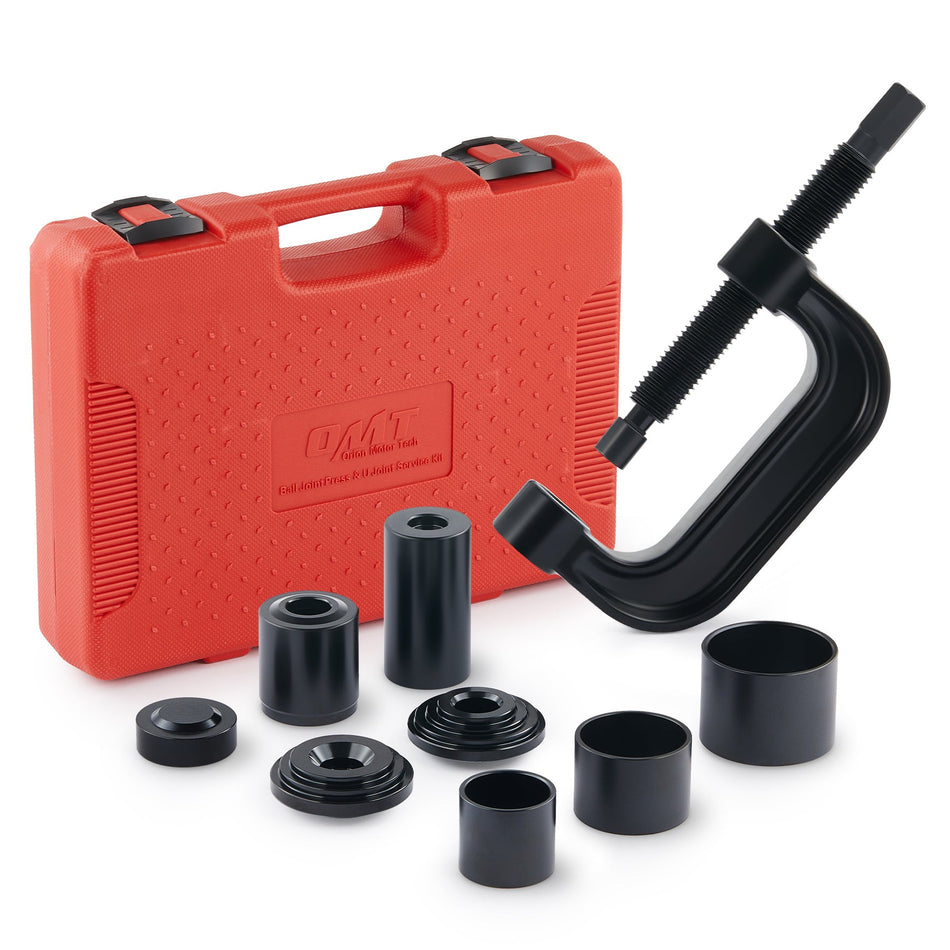
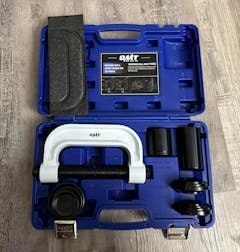
The ball joint press kit, often called a C-frame press, is one of the most commonly used ball joint removal tools. It features a heavy-duty C-clamp structure combined with multiple adapters and receiving cups of different sizes.
The ball joint press kit is specifically designed to press ball joints in and out of control arms without removing the entire assembly from the vehicle in many cases. It provides controlled, even pressure, which reduces the risk of damaging suspension components.
Best for:
Press-fit ball joint removal and installation
Professional and DIY mechanics
Heavy-duty automotive work (trucks, SUVs)
2. Ball Joint Separator (Scissor-Type)
The scissor-type ball joint separator uses a threaded screw mechanism to apply gradual and precise force to the ball joint stud. As the screw tightens, it pushes the stud out of the steering knuckle.
Unlike more aggressive ball joint tools, this design helps protect the rubber boot and surrounding parts, making it ideal when the ball joint will be reused.
Best for:
Non-destructive ball joint removal tool
Tight or delicate suspension setups
Situations requiring precision
3. Pickle Fork (Wedge-Type Separator)
The pickle fork is a simple yet powerful ball joint tool shaped like a two-pronged wedge. It is inserted between the ball joint and the steering knuckle and struck with a hammer to force separation.
While effective and inexpensive, it typically damages or destroys the grease boot, making it unsuitable if you plan to reuse the joint.
Best for:
Quick ball joint removal tool of worn or replaceable ball joints
Stubborn or seized joints
Budget-friendly ball joint press kit
4. Claw-Type Press
The claw-type press features a two-prong claw that grips the steering knuckle while a threaded forcing bolt presses against the ball joint stud.
This ball joint tool offers strong mechanical leverage and controlled force, making it effective for removing tight ball joints without excessive hammering. It’s especially useful in confined spaces where larger ball joint tools may not fit.
Best for:
Compact working areas
Controlled ball joint removal tool with minimal impact
Medium-duty applications
5. Air Hammer Forks
Air hammer forks are attachments used with a pneumatic air hammer. They function similarly to a pickle fork but rely on rapid vibrations and impacts instead of manual hammer strikes.
This makes them extremely fast and efficient for separating stubborn joints, especially in professional repair shops. However, like pickle forks, they will usually damage the boot.
Best for:
High-speed ball joint removal tool
Severely seized components
Professional workshop environments
6. Hydraulic Ball Joint Tool
Hydraulic ball joint tools use a hydraulic ram system to generate extremely high pressing force with minimal manual effort. These heavy duty ball joint tools are often part of specialized ball joint press kits designed for specific vehicles (such as heavy-duty vans or trucks).
They allow technicians to remove and install ball joints directly on the vehicle, reducing the need for full suspension disassembly and saving time.
Best for:
Heavy-duty or commercial vehicles
High-force applications
Professional mechanics handling complex jobs